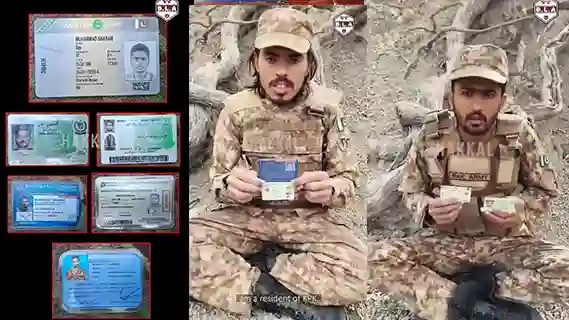
On February 14, the Baloch Liberation Army (BLA) released photographs and video clips claiming it had taken seven Pakistani soldiers into custody. The group announced a seven-day deadline, demanding the release of its detained fighters in exchange for the captives, and warned that the soldiers would be executed after February 21 if negotiations did not begin.
Soon after the footage surfaced, social media handles associated with Pakistan Army’s X Corps and the Inter-Services Public Relations (ISPR) circulated counterclaims. The narrative being pushed suggested that the men shown were not Pakistani servicemen and that the videos were digitally manipulated. By February 15, a coordinated online campaign was underway dismissing the BLA’s assertions as fabricated propaganda.
In a fresh video released subsequently, the seven captives appear together, each displaying what they identify as official Army service cards. One of them, Sepoy Mohammad Shahram, speaks while holding up both his military identification and his national identity card issued by the National Database and Registration Authority (NADRA). Visibly distressed, he questions the denial attributed to the military establishment. “If these are not genuine, then who issued them?” he asks, adding that he is the eldest son in a family where his father is disabled and dependent on him. “If we do not belong to the Army, why were we recruited?” he says.
The BLA also circulated clips featuring two other men identified as Deedar Ullah from Buner village in Khyber Pakhtunkhwa and Usman from Gujranwala. Both display identification documents and assert that they are serving members of the Pakistan Army. The armed group’s ultimatum remains set to expire on February 21, with public threats that the captives will be executed if Islamabad neither negotiates nor formally acknowledges them.
The unfolding episode has revived comparisons with the 1999 Kargil conflict, when Pakistan’s military leadership under General Pervez Musharraf initially denied that regular troops were operating across the Line of Control. At that time, mounting battlefield evidence and recovered bodies contradicted official statements, leading to international scrutiny and domestic debate over transparency.
Now, under the Junta Regime of Field Marshal Asim Munir, faces a similar test of credibility and current situation reflects a familiar strategy: contest the narrative first, manage public perception, and defer institutional accountability.
X corps and ISPR linked accounts frame the situation as part of an information war in which insurgent groups exploit digital media to apply pressure and shape global opinion.
As the BLA’s deadline approaches, the fate of the seven men remains uncertain. Beyond the immediate hostage crisis, the controversy raises broader concerns about military transparency, crisis communication, and the risks faced by personnel deployed in insurgency-affected regions such as Balochistan. Whether the episode results in negotiations, denial, or escalation, it has already triggered debate about institutional responsibility and the human cost borne by those in uniform when operations spiral into political and informational battles.