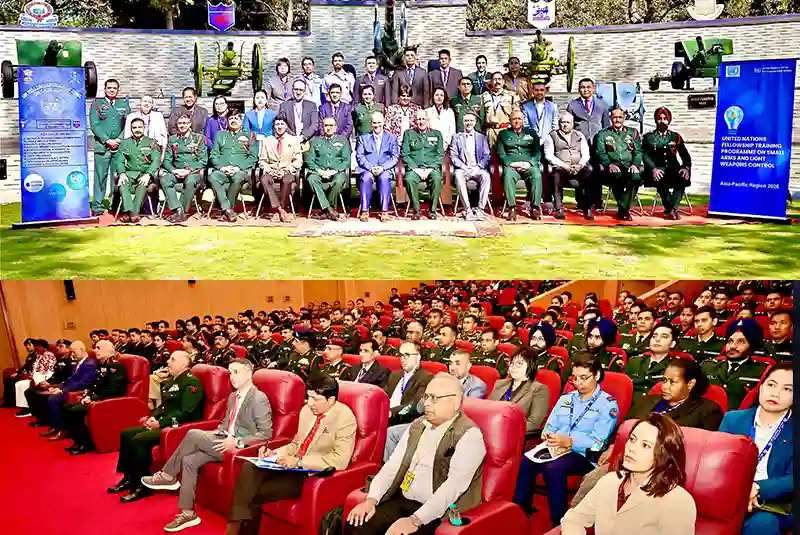
The Indian Army on Monday began hosting the inaugural United Nations Fellowship Training Programme on Small Arms and Light Weapons (SALW) Control for the Asia-Pacific region at the Military College of Materials Management (MCMM), Jabalpur. The three-week programme will run from 16 February to 06 March 2026 under the aegis of the Ministry of External Affairs (MEA) and the Ministry of Defence (MoD), and is being organised by the United Nations Office for Disarmament Affairs (UNODA) through its Regional Centre for Peace and Disarmament in Asia and the Pacific (UNRCPD).
The fellowship opened with Mr Deepayan Basu Ray, Director, UNRCPD (Asia-Pacific), outlining the UN disarmament programme, followed by a keynote address by Lieutenant General Sanjay Sethi, Commandant MCMM who underlined the strategic importance of multilateral cooperation in addressing emerging security challenges posed by illicit arms flows. He also reaffirmed India’s commitment to global peace, responsible arms governance and capacity-building partnerships under the United Nations framework.
The fellowship aims to build the technical and operational capacity of government officials tasked with implementing the UN Programme of Action (PoA) and the International Tracing Instrument (ITI), key global frameworks intended to prevent the illicit trade, diversion and misuse of small arms and light weapons. With illicit SALW proliferation a major driver of conflict, terrorism and organised crime worldwide, the initiative seeks to enhance regional cooperation, improve tracing systems and strengthen responsible stockpile management practices. Delegates from 15 Asia-Pacific nations are participating, including Australia, Bangladesh, Bhutan, Cambodia, Fiji, Iran, India, Kiribati, Kyrgyz Republic, Lao People’s Democratic Republic, Lebanon, Mongolia, Malaysia, Philippines and Thailand.
The conduct of the programme in India and the wide participation reflect growing confidence in India’s institutional capabilities and its role as a responsible, proactive stakeholder in global security governance. India’s systems for safe stockpile management, accountability mechanisms and environmentally responsible disposal of small arms and ammunition have been recognised internationally.