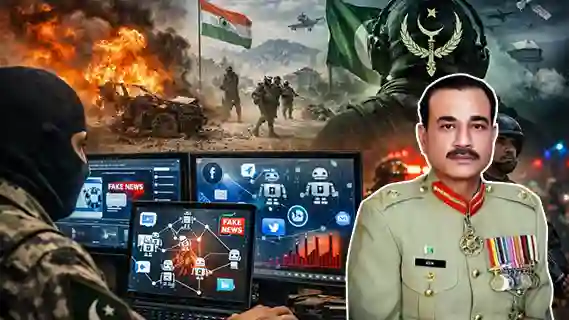
Pakistan’s intelligence agency ISI, along with the Pakistan Army’s X Corps and ISPR, has activated a coordinated “false flag” narrative targeting India over the past 48 hours, according to intelligence inputs accessed by us The narrative, first floated by ISI, claims that a potential terrorist attack could take place in India in the coming days and pre-emptively labels it as a “false flag” operation. It further alleges that Pakistani nationals lodged in Indian prisons could be used in such an operation. This messaging is being amplified in a systematic manner across Pakistan’s information ecosystem, including mainstream media and digital platforms. Leading outlets such as Dawn and Geo News are carrying the narrative, which is also being widely circulated across social media networks through coordinated amplification channels.
According to sources, the propaganda campaign was conceptualized and drafted on Monday by ISI’s Director General-Media (DG-M) Major General Muhammad Mushtaq Ali and narrative was then “planted” in leading Pakistani newspapers and TV channels.
Shortly after its publication online by Dawn, the Pakistan Army’s X Corps and ISPR initiated a wider dissemination strategy. Lieutenant General Amer Ahsan Nawaz Commander of X Corps, along with ISPR’s DG-Bravo Major General Zulfiqar Ali Bhatti have overseen the amplification phase and their team used the bot networks and affiliated social media handles to push the false flag narrative at scale.
The timing of this campaign is being viewed as significant, as it comes ahead of the first anniversary of the Pahalgam terror attack, suggesting a possible attempt to pre-emptively shape the narrative environment. Indian intelligence officials note that a similar pattern of disinformation was observed last year approximately 23 days before the Pahalgam attack when Pakistan floated comparable claims and later attempted to present them as “evidence” after the terror attack. However, these assertions were subsequently contradicted following the neutralisation of 3 terrorists involved in the Pahalgam attack and two of the three attackers were found to possess Pakistani CNICs effectively undermining Islamabad’s earlier denial and weakening its propaganda narrative globally.
Sources further reveal that in the last 11 months since the Pahalgam terror attack, Indian security forces have eliminated 34 Pakistani terrorists based on credible inputs from the Intelligence Agencies. However, more than 40 Pakistani terrorists affiliated with Pakistan-sponsored terror outfits such as Lashkar-e-Taiba and Jaish-e-Mohammed are still believed to be active in Jammu and Kashmir.
Sources added that intelligence agencies are closely monitoring recent developments, including meetings between senior ISI officials and commanders of terror outfits. In particular, meetings over the past two months involving ISI’s Sector Commander Punjab, Brigadier Rizwan Sharif, with operatives from Lashkar-e-Taiba and Jaish-e-Mohammed are also known to Indian agencies. Indian intelligence and security agencies remain on high alert, tracking both physical and information-domain threats. Officials emphasize that the current propaganda push appears to be part of a broader hybrid warfare strategy combining psychological operations with potential ground-level activities
How does the Information Operations apparatus function in Pakistan?
Information operations in Pakistan have been institutionalised since the country’s inception and have progressively evolved into a mature and well-coordinated machinery. These operations encompass a wide spectrum, including narrative warfare, propaganda dissemination, and influence campaigns.
At the core of Pakistan’s information operations lies the Inter-Services Intelligence (ISI), which serves as the principal driving force. Backed by a robust strategic intelligence and analytical framework, the ISI is well-positioned to conceptualise, plan, and steer information operations. Within the ISI, the Analysis Wing, in coordination with the Director General Media (DG(M)) and Director General Technical (DG(T)), is responsible for the end-to-end cycle—conceptualisation, planning, and execution.
The Inter-Services Public Relations (ISPR) functions as a key executing arm of this ecosystem. Additionally, during Operation Sindoor, an Information Operation Cell under Pakistan’s Ministry of Information & Broadcasting (MoIB) was observed to be actively engaged. Notably, the recently circulated “Achcha Jee” video targeting Afghanistan is assessed to have been produced by this very cell.
A centralised and unified narrative is crafted by the ISI and subsequently disseminated through a network of official and unofficial channels, including ISPR, MoIB, and multiple media platforms such as print, television, radio (including Radio Pakistan), and social media. Under the DG ISPR, the “Bravo Division” is specifically tasked with the planning and execution of information operations, operating under the broader coordination and strategic direction of the ISI. This centralised control explains the consistency and uniformity often observed in Pakistan’s messaging across platforms in response to unfolding events.
The overarching objective of this integrated information operations machinery is to shape both domestic and international perceptions through tools such as propaganda, pre-emptive narratives, and mass disinformation campaigns.
For content generation and amplification, interns recruited through the ISPR internship programme are extensively utilised. This programme was conceptualised by the ISI in 2012 during the tenure of Maj Gen Asim Salim Bajwa as DG ISPR. Since then, it has been conducted at least twice annually in coordination with relevant stakeholders. The scale of the programme has expanded significantly, with recent batches reportedly exceeding 8,000 interns.
To maintain control over the domestic information environment—including digital and social media—regulatory bodies such as the Pakistan Electronic Media Regulatory Authority (PEMRA) and the Pakistan Telecommunication Authority (PTA) are also leveraged effectively.