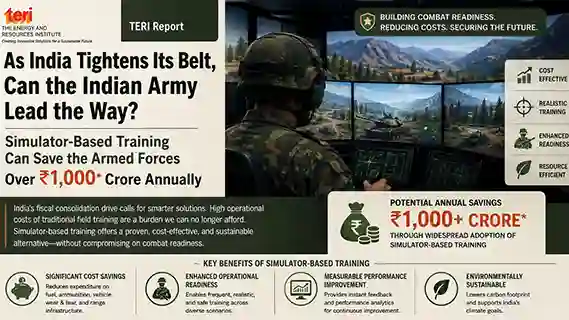
- As PM Modi calls on the nation to cut fuel and resource consumption, TERI research shows the Indian Armed Forces can lead by example, replacing live-fire training with simulators to save on fuel, ammunition, logistics, and man hours, without compromising battlefield readiness
New Delhi, 14 May 2026 | When a Prime Minister asks citizens to carpool and reconsider buying gold, the message is unmistakable: India is entering an era where every litre of fuel, every imported resource, and every rupee spent matters. Speaking recently in Hyderabad, PM Modi called for collective austerity amid rising global oil prices and mounting import pressures. The question now is: can India’s largest institutions lead by example?
A landmark study by The Energy and Resources Institute (TERI) reveals that the Indian Armed Forces are sitting on a transformational opportunity: by scaling up simulator-based training, the military can save over ₹1,000* crore annually, reducing fuel burn, cutting ammunition costs, slashing logistics expenditure, and freeing up thousands of man-hours across all combat arms, without compromising battlefield readiness
The Key Numbers: What Simulator Adoption Saves: TERI’s study assessed 13 simulator systems, covering Infantry, Artillery, Army Air Defence, Armoured Corps, and Mechanised Infantry and calculated savings across fuel, ammunition, logistics, and equipment wear. The findings are stark:
| Simulator / System | Annual NPV Savings (Current 15% Induction) | Daily Non-Induction Cost |
| 3ADS (Air Defence Simulator) | ₹2,289 crore | ₹6.27 crore/day |
| Artillery Forward Observer Simulator (FOS) | ₹2,005 crore | ₹5.49 crore/day |
| Tank Crew Gunnery Simulator (CGS) | ₹1,123 crore | ₹3.08 crore/day |
| Pinaka Simulator | ₹699 crore | ₹1.91 crore/day |
| Rocket Launcher Simulator | ₹208 crore | ₹0.57 crore/day |
| IWTS (Infantry Weapon Training) | ₹461 crore | ₹1.26 crore/day |
| ICV IMS (Mechanised Infantry) | ₹13 crore | ₹0.04 crore/day |
| MMG Simulator | ₹11 crore | ₹0.03 crore/day |
Source: TERI, Indian Armed Forces and Environmental Sustainability: A Comprehensive Assessment of Simulators in ‘Green Training’ . See Appendix A
Commenting on the report, Mr Souvik Bhattacharjya, Senior Fellow & Director, TERI, said “National security and environmental responsibility are no longer separate conversations. Defense simulators demonstrate how technological innovation can simultaneously strengthen combat preparedness, optimize resources, and advance sustainability goals.”
At the current 15% simulator induction level, the Indian Army’s Infantry Weapon Training Simulators alone save ₹461.20 crore annually equivalent to ₹1.26 crore every single day. If induction were scaled up by a further 25%, annual savings from IWTS alone would increase by ₹3219.50 crore.
Simulator-based training drives savings across four critical cost heads:
- Ammunition Costs: The total monetary savings from ammunition, assuming a 15% reduction in FOS Artillery, is estimated at ₹135 crore. At the current 15% induction level, the Pinaka system is projected to generate Net Present Value (NPV) savings of ₹10,228.55 crore.
- Fuel and Logistics: Every live-fire exercise requires troop convoys moving 1,000 km round trips. For Mechanized Infantry, it consumes 2 lakh litres of diesel annually at ₹1.7 crore. Driving Training Simulators eliminate fuel use from vehicle training entirely, saving further costs across all five combat arms.
- Equipment Wear: Tank simulators (CGS) preserve expensive T-72/T-90 main battle tank barrels and systems, with annual NPV savings of ₹1,123.04 crore translating to ₹3.08 crore saved per day from reduced platform wear.
- Man-Hours and Readiness: Live-fire range exercises require days of preparation, movement, and post-exercise administration. Simulators allow repeated, high-fidelity training cycles without logistical downtime, improving personnel readiness and reducing the hidden cost of lost training time.
India’s military budget is the third largest in the world. A significant share goes toward ammunition and equipment consumed in training that can be replicated and in many respects improved through simulation. The case for smart military training has never been more financially, environmentally, or strategically compelling.
TERI’s Recommendations:
- Scale simulator induction beyond the current 15% across all combat arms, a 25% increase in induction unlocks savings of over ₹3,219 crore from IWTS alone.
- Integrate simulators into joint training exercises across all service branches, including Agniveers, to maximise per-unit training value.
- Invest in AI-driven and virtual reality simulators to improve training realism while reducing the frequency of live-fire exercises.
- Adopt data-driven performance analytics within simulator platforms to evaluate trainee progress in real time, reducing the need for repeat live exercises.
- Frame simulator adoption explicitly within India’s Atmanirbhar Bharat and defence modernisation agenda domestic simulation capability is both strategically and economically sound.
*The cumulative annual savings of INR 1,000 Cr has been derived from assuming simulator penetration goes above 40%.
About TERI: The Energy and Resources Institute (TERI) is an independent, not-for-profit research organization advancing innovative solutions in energy, environment, climate change, and sustainable development. Headquartered in New Delhi, with regional centres in Gurugram, Bengaluru, Guwahati, Mumbai, Panaji, Nainital, and Hyderabad, TERI is powered by a 1,000+ strong multidisciplinary team of scientists, engineers, economists, and sociologists engaged in action-oriented research and implementation.