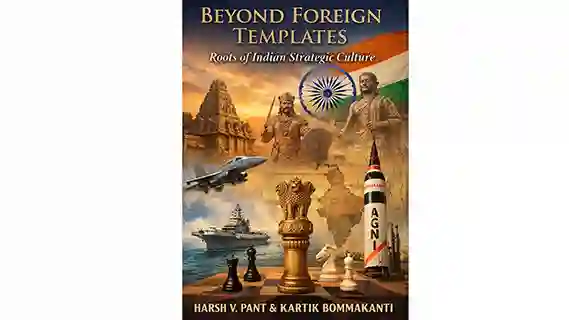
For much of the recent era, a dominant narrative in international relations discourse has suggested that India lacks a coherent strategic culture. This critique articulated by certain Western Thinktank, posited that Indian strategic thought was largely ad-hoc, reactive and defensive. Critics argued that the Indian concept of time, cyclical and infinite, prevented long-term strategic planning. They pointed to the absence of a single, unified “Indian War Doctrine” or historical documents comparable to the military archives of Prussia or the strategies of the Colonial Empires.
However, this criticism suffers from a blind spot, as it judges Indian strategy by foreign templates. This view fails to recognise that Indian strategic culture is not monolithic in the Western sense, rather it is civilizational. It is embedded in the civilisational strength and the ethical codes that have governed statecraft for millennia. The Indian strategy in reality is ever evolving, yet has its roots to sophisticated preference for principled flexibility, strategic restraint and calculated use of force.
Realist Counter: Sun Tzu, Clausewitz, Machiavelli vs Kautilya – Valluvar
The Western and certain Asian ideas of strategy are dominated by Sun Tzu’s deception, Clausewitz’s “war as politics” and Machiavelli’s “ruthlessness”. Indian ways are more aligned with the Arthashastra and strategically profound Thirukkural.
While Machiavelli’s The Prince is often cited as the ultimate manual on power, Kautilya’s Arthashastra (300 BCE) precedes it by 1,500 years and offers a far more granular approach to statecraft. Unlike Sun Tzu, who focuses largely on the battlefield, Kautilya focuses on the Mandala (Circle of States), a geopolitical algorithm. Kautilya defines the Saptanga (Seven Limbs of the State), placing the King and Ministers alongside Forts and Treasury. This anticipates modern “Comprehensive National Power” indices.
Often obscured as a book of Tamil poetry, the Thirukkural by Thiruvalluvar (300 BCE – 2nd Century CE) contains the Porutpal (Chapters on Wealth/State), which offers a startlingly sharp counter to Clausewitz. Where Clausewitz sees war as an extension of politics, Valluvar sees war as a failure of defence and diplomacy, yet prepares for it meticulously.
- On Foreign Policy and Alliances: “To discern the enemy’s strength, one’s own strength and the strength of one’s allies and then to act – that is strategy” (Kural 471).
- Importance of Army: “An army which is complete in its components and conquers without fear of wounds is the chief wealth of the king” (Kural 761).
Valluvar counters the brute force narratives by emphasising Aran (Fortification). He argues that a fort is not just a wall, but a system of economic sustainability during a siege, a lesson pertinent to modern economic sanctions.
Philosophical Counter: Aristotle, Plato, Socrates vs Mahabharata, Thirukkural
Western political philosophy, rooted in the Hellenistic tradition, seeks the “Ideal” Plato’s Republic imagines a utopia ruled by philosopher-kings, Aristotle categorises constitutions. Indian thought, however, is deeply rooted in the “Real” and the “Contextual”.
Aristotle seeks a golden mean in virtue. The Mahabharata, rejects the binary of Good vs Evil for the complexity of Dharma (Duty). When Arjuna questions the morality of killing kin, he was not offered a platitude about “justice”, rather he was offered the treatise on Dharma-Yuddha (Just War).
The Mahabharata teaches that non-violence (Ahimsa) is the highest Dharma, but the protection of the innocent requires the capacity for war. This nuance is often missing in Western idealism. Bhishma, on his deathbed, instructs Yudhishthira that a King must be “like a gardener” (nurturing) but also “like a garland maker” (plucking flowers before they wilt), a metaphor for pre-emptive strikes against threats.
Valluvar wants a ruler trained in listening, “King who does not have the courage to listen to bitter advice will perish, even without enemies” (Kural 448). This counters the Western authoritarian tendency often found in Platonism. The Thirukkural posits that the legitimacy of the state rests not on divine right or intellectual superiority, but on Sengol (Righteous Sceptre/Good Governance).
Way of Life Counter: Confucius vs The Indian Triad
Confucianism, emphasises hierarchy, ritual and saving face. It seeks order through conformity. The Indian triad Arthashastra, Mahabharata, Thirukkural, counters this by emphasising Dharma which binds even the King.
Mahabharata is a lesson in the dangers of gambling with state sovereignty. The 18-day war is a case study in alliance management, psychological warfare and the heavy cost of victory. It teaches a “Way of Life” that accepts volatility rather than the Confucian desire to freeze social structures.
Similarly, labelling the Thirukkural as poetry undermines its status as a manual for all – Strategist, King and Householder alike. Unlike Confucius, who separated the rulers from the ruled via complex rituals, Valluvar integrates the domestic and the political. He argues that a state is only as strong as the families within it. This highlights that strategic autonomy is a way of life, requiring the patience to wait for the opportune moment (Kaalam), a distinct counter to the Confucian emphasis on rigid ceremonial action.
Return of the Civilizational State
In the present scenario of a volatile world, marked by shifting alliances, grey-zone warfare and economic weaponisation, the relevance of these Indian treatises is undeniable. India’s modern defence and diplomatic outreach are not mimicking the West they are aligning towards its civilisational routes. India’s refusal to be dragged into binary blocs and maintaining Multi-Alignment is a direct application of the Arthashastra’s strategy, maintaining strategic autonomy while engaging with all sides.
The “Strategic Restraint” often mistaken by the others is actually Thirukkural’s wisdom of “waiting for the right time” and yet prepared for war. The recent assertive posturing reflects the Mahabharata’s lesson: when everything fails, the display of power (Danda) is the only path to peace. India’s “Vaccine Maitri” and role as a “Net Security Provider” in the Indian Ocean reflect the Dharmic obligation of the state to contribute to universal welfare.
Indian strategic culture is very much alive in the living ethos of the civilization that treats the Mahabharata as the soul, the Arthashastra as a thought and the Thirukkural as a conscience. By recognising the strategic weight of these texts, the world can better understand the rise of India, a stabilising pole in the global order.
About the Author
Srikumar Bharathi P is an officer in the Indian Army with experience in Counter Terrorism and United Nations Peace Keeping operations. The officer has authored a book on China and has been a regular contributor of articles on matters of Strategy, Defence and Geo-Politics.
Disclaimer – The views expressed, suggestions made & quoting of prominent personalities in the article are solely the responsibility of the author and do not have any official endorsement.