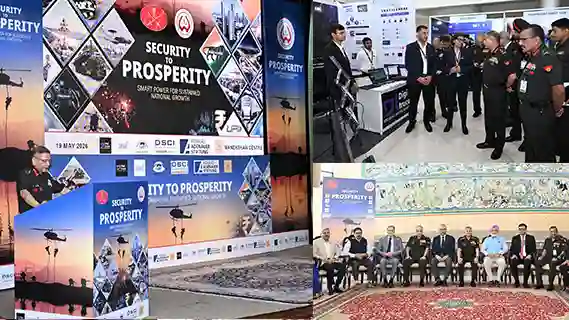
The Chief of the Army Staff (COAS), General Upendra Dwidevi inaugurated a seminar titled “Security to Prosperity: Smart Power for Sustained National Growth” in Manekshaw Centre, New Delhi today. The seminar was conducted by the Centre for Land Warfare Studies (CLAWS). It brought together policymakers, diplomats, senior military leadership, industry representatives and strategic experts to deliberate upon the integration of military, diplomatic, economic and technological instruments of national power for ensuring sustained national growth and strategic resilience.
The seminar was organised against the backdrop of an increasingly interconnected and volatile global environment, wherein national security and economic prosperity are becoming deeply interlinked. The concept of ‘smart power’, which formed the central theme of the seminar, was examined as a framework for the calibrated integration of hard and soft power capabilities, enabling India to strengthen its strategic autonomy while preserving economic engagement and diplomatic outreach.
Speaking at the seminar, the COAS said that the growing convergence between national security and economic prosperity in an increasingly volatile global environment. Referring to India’s vision of Viksit Bharat 2047 and the Indian Army’s ongoing “Decade of Transformation”, the COAS underlined the importance of digital networking, data-centricity and physical connectivity as key pillars for future preparedness. Drawing upon the conduct of Operation Sindoor in May 2025, he described the operation as a demonstration of “smart power”, wherein military precision, information management, diplomatic signalling and economic resolve were synchronised as one coherent national act. He emphasised that the deliberate termination of operations after achieving clearly defined objectives reflected the calibrated application of national power.
Highlighting the emergence of a “new normal of hard power” in global geopolitics, the COAS observed that security and prosperity can no longer be viewed as separate domains, with supply chains, technology ecosystems and critical resources increasingly becoming instruments of strategic competition. Outlining a “SMART” framework for India’s strategic approach, he emphasised the need for integrated statecraft, manufacturing depth, accelerated innovation, resilience against external dependencies and technology primacy. Stressing the importance of Aatmanirbharta, whole-of-nation synergy and strategic autonomy, he called for deeper collaboration between the military, industry and academia to secure India’s long-term growth and national interests. Concluding his address, the COAS reiterated that peace is sustained not merely through the absence of conflict, but through capability, confidence and national resolve.
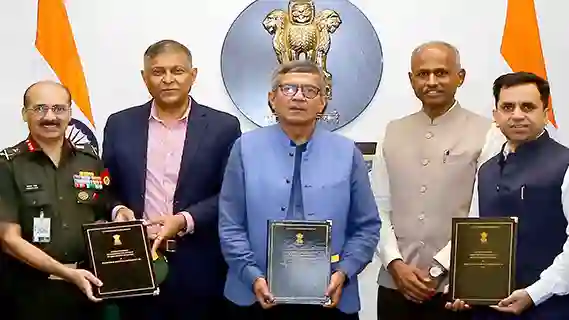
During the event, the COAS also visited the accompanying technology exhibition and unveiled the book ‘Maratha Sainya Vyavastha (Shivaji to the Third Battle of Panipat)’, a scholarly work tracing the evolution of the Maratha military system and its relevance to Indian strategic thought.
The intellectual discourse of the seminar was structured around two special addresses and two panel discussions. A special address on the transformative role of niche technologies in military capability development was delivered by Dr Prateek Kishore, Director General DS & DG (ACE), DRDO, wherein emphasis was laid on indigenous research and development for strengthening India’s defence-industrial base and reducing strategic vulnerabilities.
An external perspective on contemporary geopolitical developments was presented by Mr Georg Enzweiler, Deputy Head of Mission, Embassy of the Federal Republic of Germany. The implications of shifting global power structures, erosion of multilateral norms and their impact on the international order and India’s strategic options were highlighted during the address.
The first panel discussion, moderated by Lieutenant General Rakesh Kapoor (Retired), focused on India’s strategic choices amid ongoing global turbulence. An assessment of the West Asia crisis was presented by Mr Ram Madhav, President, India Foundation. Deliberations were also carried out on disruptions in supply chains related to energy, food and critical minerals, and on the necessity for resilient alternative arrangements to safeguard India’s strategic autonomy.
The second panel discussion examined the evolving character of warfare and the growing significance of cybersecurity, digital defence and emerging technologies. The Indian Army was represented at the level of DG Capability Development and ADG Army Design Bureau, while perspectives on next-generation technological integration and cyber resilience were shared by industry representatives from SRGF, the Data Security Council of India, Medjay Technologies and the CyberPeace Foundation.
The seminar was designed to be outcomes-oriented, with discussions aimed at generating policy recommendations for enhancing India’s strategic autonomy, strengthening collaboration between government, industry and academia, and identifying priority investment areas in emerging and disruptive technologies.
The seminar sought to reinforce the idea of security as an enabler of prosperity and explored how India can leverage its civilisational resilience and expanding strategic capacities to transform contemporary challenges into opportunities for national growth and global leadership.