November 4, 2026
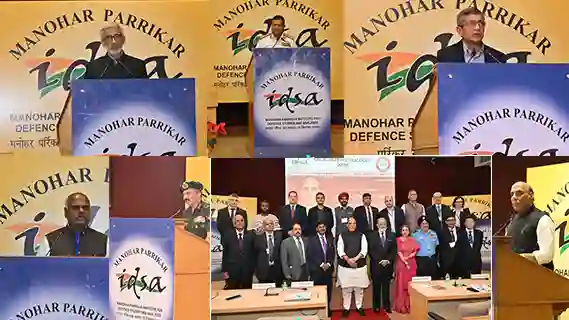
New Delhi: The third edition of the Delhi Defence Dialogue (DDD) 2026, organised by the Manohar Parrikar Institute for Defence Studies and Analyses (MP-IDSA), New Delhi, on the theme ‘Defence Reforms, Atmanirbharta (Self-Reliance), Collaborations and Exports’, concluded with a Valedictory Address by Prof. Ajay Kumar Sood, Principal Scientific Adviser to the Government of India, on ‘From Platform to Foundation: Science and Technology for Defence Atmanirbharta @2047’. The session was chaired by Ambassador Sujan R. Chinoy, Director General, MP-IDSA.
At the outset, Prof. Sood congratulated Amb Sujan R. Chinoy, Director General, MP-IDSA, and his team for successfully organising an international conference that deliberated on critical issues shaping India’s defence and security landscape. He emphasised that achieving Atmanirbharta and the vision of Viksit Bharat 2047 requires sustained investment in science, technology, research and innovation. Highlighting the changing nature of warfare and the growing significance of emerging technologies such as artificial intelligence, drones, quantum technologies, semiconductors and advanced communication systems, he stressed the need to strengthen India’s indigenous technological capabilities. He observed that while India has made significant progress in developing defence platforms, greater emphasis must be placed on critical subsystems, components and materials to reduce external dependencies.
Prof. Sood underscored the importance of building an integrated defence innovation ecosystem through collaboration among DRDO, public and private sector industries, startups, universities and the Armed Forces. Referring to key government initiatives, including the Anusandhan National Research Foundation, Research Development and Innovation Fund, National Quantum Mission, India Semiconductor Mission and India AI Mission, he highlighted the growing institutional support for indigenous research and development in strategic technologies.
Outlining six priority shifts for achieving defence self-reliance by 2047, he called for involving defence users as development partners from the design stage; adopting long-term and pooled demand planning; prioritising foundational technologies; establishing shared testing and certification facilities; developing specialised scientific and technical talent; and strengthening international partnerships and defence exports. He also emphasised that collaborative research, equitable technology-sharing arrangements and robust domestic manufacturing capabilities would be essential to building a globally competitive defence industrial ecosystem.
The Valedictory Address reaffirmed that India’s journey towards defence Atmanirbharta must be anchored in scientific excellence, technological depth, sustained innovation and strategic collaboration. The vision of a self-reliant, technologically advanced and export-ready defence ecosystem by 2047 will require stronger linkages between research institutions, industry, academia and the Armed Forces, alongside sustained national commitment to emerging and foundational technologies.
The Delhi Defence Dialogue 2026 provided a platform for deliberations on key policy priorities, defence reforms, indigenous technological development and international cooperation, with the objective of strengthening India’s defence preparedness and advancing its emergence as a leading global defence manufacturing and export hub.