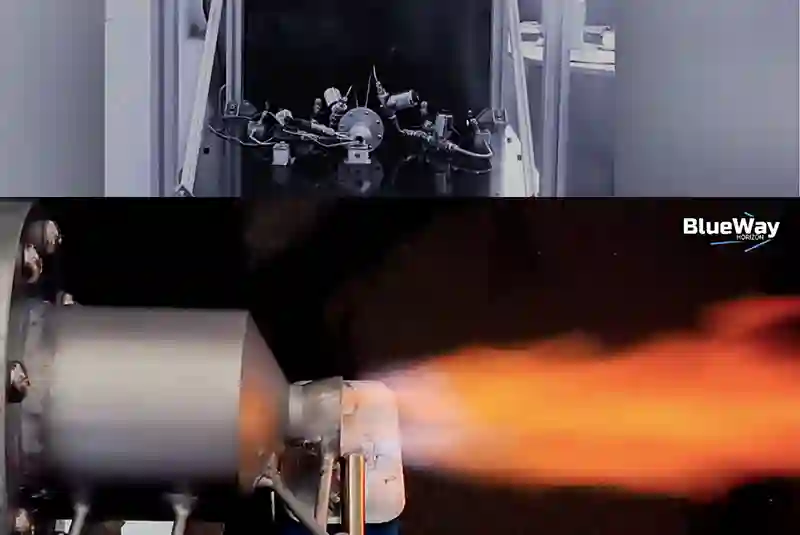
BlueWay Horizon, a space technology startup incubated at TIDES, IIT Roorkee, has successfully completed the hot-fire testing of its ALPHA 120N green propulsion engine, a key subsystem for Horizon-I, the company’s reusable orbital return platform being developed for microgravity research and payload return missions.
The test was conducted at BlueWay Horizon’s IMPULSE ONE propulsion test facility established at TIDES, IIT Roorkee, marking a significant milestone in the company’s journey toward developing indigenous spacecraft technologies for orbital operations and controlled Earth return.
Founded by aerospace engineers and former ISRO interns Nandan Kumar Jha and Pranjit Sharma, BlueWay Horizon is focused on building a reusable space transportation platform that enables pharmaceutical, biotechnology, semiconductor, advanced materials, and deep-tech companies to conduct experiments in microgravity and reliably return them to Earth.
Microgravity has emerged as a powerful environment for developing next-generation pharmaceuticals, protein crystals, advanced materials, semiconductors, and biotechnology products. However, access to orbital research platforms and payload return capabilities remains limited and expensive worldwide. Horizon-I is being developed to address this challenge by providing an autonomous and cost-effective platform capable of carrying research payloads to orbit and bringing them back safely for analysis and commercialization.
The successful ALPHA 120N engine test validates a critical technology required for orbital maneuvering, mission operations, controlled deorbit, and re-entry support functions. Designed with a focus on operational simplicity, reliability, and scalability, the propulsion architecture reduces ground handling complexity while supporting future reusable spacecraft missions.
As the global space industry expands beyond traditional government-led programs, there is increasing adoption of next-generation green propulsion technologies. European space programs and commercial operators have actively invested in alternatives to conventional hydrazine-based propulsion systems, seeking safer, more sustainable, and operationally efficient solutions for future spacecraft.
According to BlueWay Horizon, the ALPHA engine represents the first step in a broader propulsion development roadmap. The company is currently advancing the next generation of propulsion systems, including the BETA and GAMMA thrusters, which are being developed at different thrust levels to support various mission phases of the Horizon-1 platform.
“The future space economy will depend on reliable orbital return capabilities, and Horizon-I is being built to help enable that future,” said Nandan Kumar Jha, Founder and CEO of BlueWay Horizon.
The successful firing of the ALPHA thruster demonstrates the growing capability of India’s private space sector to develop critical spacecraft technologies domestically. With reusable re-entry systems, advanced propulsion technologies, and a focus on enabling space-based manufacturing and research, BlueWay Horizon aims to contribute to the development of a robust microgravity economy while making orbital research more accessible and affordable.
As development of Horizon-I progresses, BlueWay Horizon continues to move toward its long-term vision of establishing a reliable orbital return ecosystem that enables scientific institutions, startups, and industrial partners to access microgravity and recover high-value research payloads efficiently.