Lauds GTRE for bolstering national security through self-reliance
“Govt is committed to achieving self-reliance in aero engines development”
“Op Sindoor demonstrated India’s growing Aatmanirbharta in defence, Need to focus more on manufacturing world-class indigenous systems”
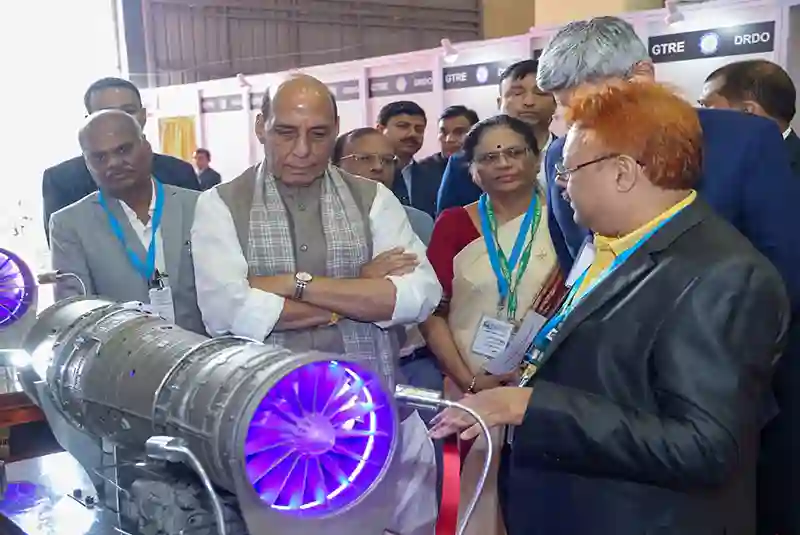
Raksha Mantri Shri Rajnath Singh, on February 16, 2026, visited DRDO’s Gas Turbine Research Establishment (GTRE) in Bengaluru, and reviewed the status of ongoing projects relating to indigenous military gas turbine engine development. He was briefed on the establishment’s projects on the anvil, interactions with the Indian Industry, academia and R&D institutes, and the support provided to the defence forces. He also visited the exhibition showcasing various indigenous engines & their parts and witnessed the full afterburner engine test of the Kaveri engine.
Interacting with the scientists and officials, Raksha Mantri praised GTRE for its efforts towards bolstering national security through self-reliance, describing DRDO as the foundation of India’s strategic capability. He underscored the critical importance of achieving Aatmanirbharta in aero engine technology in the present rapidly evolving geopolitical landscape, and stated that every effort is being made to prioritise the development of aero engines in India. “Supply chains are breaking and new ecosystems are developing. Nations possessing indigenous critical technologies will remain safe, secure, and sustain themselves,” he stated, reiterating Prime Minister Shri Narendra Modi-led Government’s commitment to achieving self-reliance in every field.
Acknowledging GTRE’s efforts in this critical technology domain, Shri Rajnath Singh exhorted the lab to strive and focus on next generation engines by building a nationwide robust ecosystem, while achieving self-reliance in aero engines. He added that “We are rapidly moving towards the design and development of the Advanced Medium Combat Aircraft (AMCA). We have made numerous attempts in the past to achieve expertise in the field of aero engines. Now, the time has come to complete those efforts. We cannot limit ourselves to only 5th generation engines. We must begin the development of 6th generation, advanced technologies as soon as possible. Research on them is the need of the hour. The use of Artificial Intelligence, Machine Learning and new materials is increasing. We must stay ahead of the curve.”
Raksha Mantri described aero engine development as an extremely complex endeavour, integrating thermodynamics, material science, fluid mechanics and advanced mechanical engineering. Noting that even developed nations often take 25-30 years to develop next-generation engines, he urged Indian scientists to compress timelines in view of the nation’s strategic needs. “We must assume that 20 years have already passed and we now have only 5-7 years left,” he said, describing it as a call to action aligned with national aspirations.
Referring to Operation Sindoor, Shri Rajnath Singh emphasised that during the operation, the defence forces demonstrated India’s growing Aatmanirbharta in the defence sector. “Whether it was communication systems, surveillance equipment, or attack weapons, everything was indigenous. This boosted the morale of our soldiers and instilled pride among citizens. In view of the evolving challenges, it is imperative to focus more on indigenous methods and provide our forces with world-class systems and equipment,” he said.
Raksha Mantri praised GTRE for the joint study with the UK for aero engine development, adding that the process has been initiated with France as well for aero engines under the National Aero Engine Mission. “Both France and UK are very advanced in aero engine technology. These collaborations will not only provide us with the opportunity to learn new technologies, but also help us to understand the challenges they have faced over the past decades,” he said.
Shri Rajnath Singh also highlighted the dual-use potential of such complex technologies, stating that GTRE is making high-temperature composites, which could significantly benefit civil aviation, power generation and space sectors in the future. He stated that India is one of the fastest-growing civil aviation markets in the world and technological advancements achieved today in defence aero engines could play a transformative role in civil aviation and economic growth tomorrow.
Raksha Mantri called for capitalising on the numerous opportunities India provides, making special mention of the free trade agreement between India and the European Union, which had been pending for 18 years, has now been completed. This trade agreement is an acknowledgement of India’s growing economic and political power, he said. He also referred to his recent meeting with the Defence Minister of Greece, who he said, views India not as an emerging power, but as a superpower.
Secretary, Department of Defence R&D and Chairman DRDO Dr Samir V Kamat and senior scientists & officials of GTRE were present on the occasion.